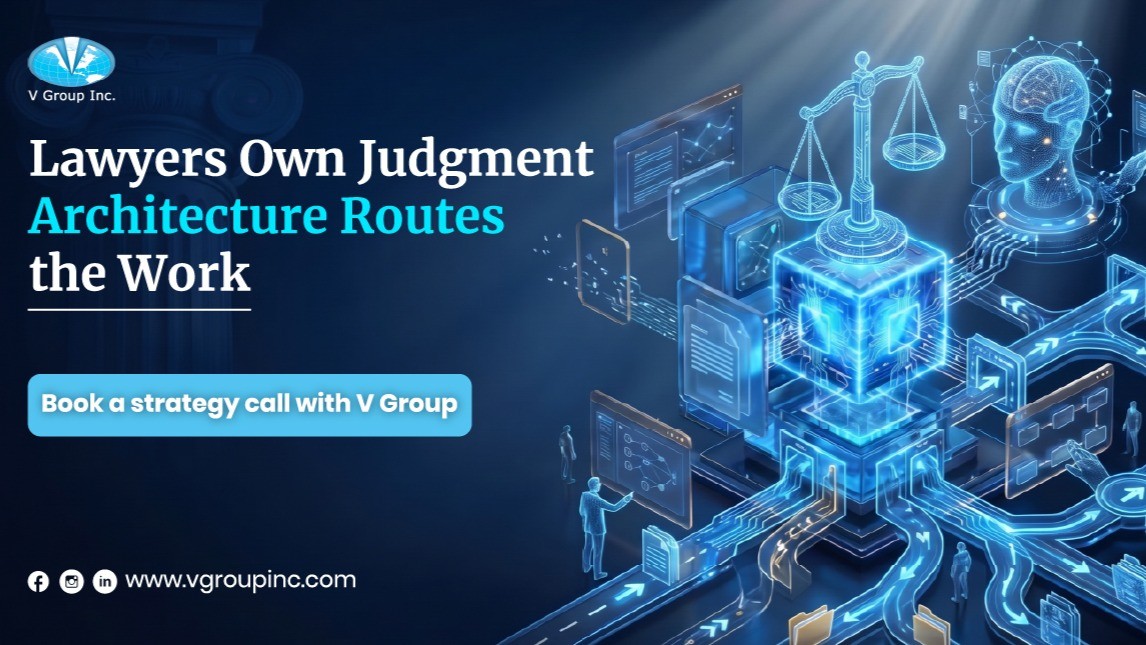
With AI adoption at 88% of organizations, getting access to AI is easier than ever. The real challenge (and opportunity) is turning that intelligence into a different way of working. Clients no longer distinguish one law firm from another by who has the most powerful AI stack.
Nor do the Courts, which nonetheless hold the lawyer accountable under Local Rule AT-3 for “the exercise of independent legal judgment”. In practice, using AI-generated work product carries a representation to the Court, vide FRCP Rule 11, that the factual contentions are supported by evidence, or where identified accordingly, that reasonable investigation or discovery is expected to establish that support.
As major technology companies like Google move deeper into legal technology, firms are increasingly likely to have access to many of the same underlying AI capabilities. That makes us wonder:
If every law firm uses the same AI, where does the competitive advantage come from?
Our ILTACON 2026 experience has confirmed what we were already learning from our clients. The competitive advantage did not come from the license, or the model, for long. As Thomson Reuters has pointed out, the dashboards showing 74% of professionals using AI several times a week do not translate into internal transformation.
At V Group, we build the orchestration technology that connects AI technologies, workflows, data, and systems, so intelligence doesn’t sit in isolated tools, but works across the firm.
The AI advantage has three layers
Most conversations about AI still begin at the first layer. That’s understandable. But many firms are still struggling to move from AI adoption to operational change. As per Thomson Reuters’s report, this execution gap across strategy, client delivery, governance, and talent is where the competitive risk lies.
1. Intelligence
This is the model itself. The copilots, the legal research tools, the drafting assistants- a lawyer might just call them agents.
This layer is improving rapidly and becoming increasingly accessible. A firm may spend months evaluating which AI capability is best, only to find that the competitive landscape has shifted again by the time the decision is made. A Stanford report explains how the rapidly changing frontier performance may lead to benchmarks being saturated in months and the competitive gap between leading models narrowing.
That’s not a reason to ignore the technology. It’s a reason not to mistake access for advantage.
The model may matter. But as frontier capabilities become more widely available, access to the model itself is becoming a weaker source of competitive differentiation.
2. Infrastructure
This is where AI meets the firm, making law professionals verify:
- Does the technology access the right information?
- Does it understand the matter and the context around the work?
- Does it respect matter boundaries, ethical walls, permissions, and confidentiality requirements?
- Can it retrieve the right knowledge without forcing lawyers to search across multiple systems?
- Can different AI capabilities work within the same environment?
- Can the firm trace what happened when AI contributed to the work?
This is where the problem stops being procurement and starts becoming architecture and technology leadership becomes strategic. Because two firms can buy access to the same AI model.
But one may have the infrastructure to make that same model far more useful in terms of real legal work.
3. Operations
This is the layer where the advantage becomes visible. Intelligent agents make the work move differently, with reviews happening differently. Lawyers spend less time assembling information and more time applying judgment. The firm creates more capacity, which translates into evolved staffing models and improved turnarounds.
This is where AI stops being a technology decision. And becomes a business decision.
A firm doesn’t win because its lawyers have AI. It wins when the way it delivers legal work becomes harder for competitors to match.
That is the difference between AI adoption and AI advantage.
AI is advancing fast. Are firms changing just as fast?
The evidence is increasingly clear: AI usage is a poor proxy for AI transformation.
A lawyer using AI for research does not necessarily mean the research workflow has changed. An associate using AI to draft a document does not necessarily mean the matter is moving faster. A team using AI in document review does not necessarily mean the economics of review have improved.
The technology can change one step without changing the system around it. Thomson Reuters’ research describes exactly this gap: firms may have AI strategies and widespread usage while the way matters are run, staffed, and delivered to clients remains largely unchanged.
That is why leadership needs to measure something more meaningful than activity.
The Firms That Win Won’t Necessarily Look More “AI-Powered”
The firms that build an early advantage with AI may not look dramatically different from their competitors from the outside. They may not have the most AI tools, or the highest adoption numbers. They may not be the firms making the most noise about AI.
But internally, the way work gets done will be different. Their lawyers spend less time assembling the information needed to begin the work. Their matter team spends less time recreating context as work moves between people and systems. AI handles appropriate portions of routine review, allowing lawyers to focus more of their time on judgment and decision-making. Knowledge that once lived across documents, inboxes, and individual lawyers becomes easier to find, connect, and apply. Routine coordination requires fewer manual handoffs.
And the difference eventually reaches the client. When work moves faster, the service changes, triggering a spike in the economics and the commercial model itself.
That is already becoming visible in the market. That is what advantage looks like.
And that is why the firms that win with AI may not be the ones that look the most AI-powered. But according to McKinsey’s July 2026 research, they will be the ones that work differently.
The question I would ask every law-firm leadership team
Not, “Which AI tool should we buy next?”. And not, “What is our AI adoption rate?”. I would ask something more uncomfortable:
If every law firm in our market had access to the same AI tomorrow, what would make ours better at using it?
The answer cannot be more licenses. It cannot be more prompts. It cannot be a better adoption dashboard. The answer should be visible in how the firm works. That is where competitive advantage starts to emerge.
The underlying AI will increasingly be shared. The operating model around it will not.
Two firms can buy the same AI. One may have AI. The other may have an operating advantage.
That distinction matters. Because the firms that figure out how to turn AI into better workflows, greater capacity, stronger knowledge leverage, and better client delivery will not simply be adopting technology faster.
They will be building a better way to deliver legal work.
And that is a much harder advantage to copy.
The Conversation Has Moved On.
Through the V Group-sponsored ILTA Roadshows, we are asking what comes after AI adoption.
When firms have multiple models, AI capabilities, connected systems, and autonomous agents, how do they make them work as one?
If you have moved beyond “Should we use AI?” to “How should AI work here?”, join the conversation.
V Group ILTA Roadshows
The next AI advantage is architectural.
RESOURCES
- https://hai.stanford.edu/ai-index/2026-ai-index-report/economy
- https://txed.uscourts.gov/?q=node%2F11632
- https://www.law.cornell.edu/rules/frcp/rule_11
- https://www.axios.com/2026/09/08/googles-gemini-enterprise-legal-halimah-delaine-prado
- https://www.thomsonreuters.com/en/institute/future-of-professionals-2026/report
- https://hai.stanford.edu/ai-index/2026-ai-index-report/technical-performance
- https://www.mckinsey.com/industries/industrials/our-insights/the-operating-model-advantage-why-ai-winners-are-rewiring-their-organizations
- https://legal.thomsonreuters.com/blog/legal-future-of-professionals-executive-summary/
- https://www.mckinsey.com/industries/industrials/our-insights/the-operating-model-advantage-why-ai-winners-are-rewiring-their-organizations