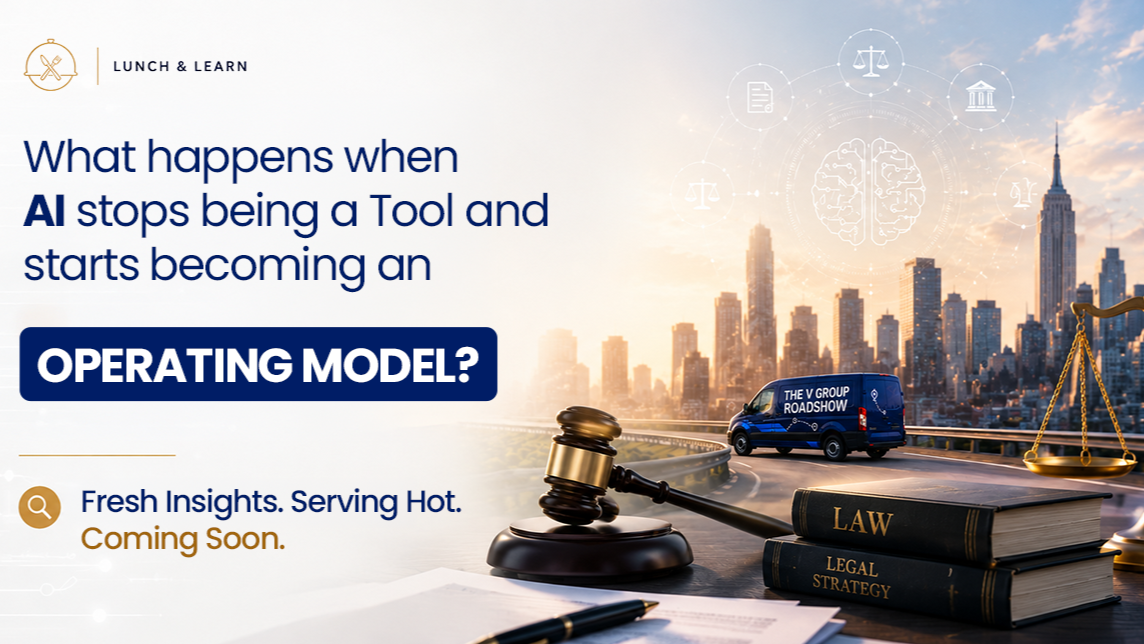
My unfiltered thoughts from five days at ILTACON 2026 and a few key takeaways that continue to stand out.
There is always a certain energy that comes with ILTACON.
For a few days, the legal industry’s brightest minds gather in one place. Conversations move quickly. New technologies are unveiled. Existing assumptions are challenged. Everyone is trying to understand not only where the market is today, but where it is heading next.
Having just returned from ILTACON 2026 in Nashville, I found myself reflecting less on the AI products being showcased and more on the questions being asked by legal leaders.
Because for the first time in several years, the dominant conversation was not about whether firms should adopt AI. That question appears largely settled.
The conversation has matured.
What I heard repeatedly from General Counsel, CIOs, legal operations leaders, and technology executives was something far more practical: How do we make all of this work together?
Strategic Planning Assumption
By 2027, the firms that realize the greatest value from AI will not necessarily be those with the most AI tools, but those that can make their AI, data, and workflows operate as one connected environment.
At ILTACON 2026 in Nashville, V Group Inc. had conversations with GCs, technology leaders, legal operations professionals, and other industry stakeholders about where firms are taking AI next.
One message came through clearly: the AI adoption conversation is changing.
Many firms have already invested in AI. The real challenge comes when they try to integrate AI into the way their firms already work. That means connecting AI with existing systems, information, permissions, workflows, and governance without creating another layer of technology fragmentation is a big hurdle.
The Challenge
The AI Coordination Gap
As firms add AI across research, drafting, knowledge management, document workflows, eDiscovery, and operations, the technology environment becomes increasingly fragmented.
Individual tools may perform well. But they never communicate within themselves.
How do these systems work together?
1. The Growing AI Stack
Firms are adopting multiple AI capabilities rather than a single platform.
The result can be duplicated functionality, disconnected workflows, multiple interfaces, and fragmented context.
The challenge is no longer access to AI. It is coordinating AI.
2. Context Does Not Move With the Work
A lawyer may work across a DMS, Microsoft 365, knowledge systems, practice applications, and multiple AI tools.
When those systems operate independently, lawyers become the integration layer—moving information, repeating prompts, and manually transferring outputs between applications.
That creates an invisible operational cost.
3. Integration Without Governance Creates New Risk
Connecting systems is not enough.
As AI begins to retrieve information, select tools, trigger workflows, and generate outputs, firms need visibility into what happened.
- What information was accessed?
- Which system provided it?
- Which AI was used?
- What action was taken?
- Where did human judgment enter the process?
Integration and governance therefore cannot be treated as separate initiatives.
The Solution: An Intelligence Layer for Legal Work
The next phase of legal AI is not about replacing the firm’s existing technology stack. It is about connecting intelligence to it.
An effective AI architecture should be able to:
Ask → Identify → Route → Retrieve → Execute → Review
The objective is simple: allow the right AI, system, information, and workflow to work together while maintaining the firm’s security, permissions, and governance requirements.
This is where AI moves from an individual productivity tool to an operational capability across the firm.
Beyond Adoption: The Architecture of Integrated AI
To move from AI adoption to operational AI, firms should evaluate five areas:
1. Connected Systems
Can AI work across the applications and repositories the firm already uses?
2. Intelligent Routing
Can the firm determine which model, agent, system, or workflow should handle a particular task?
3. Context and Permissions
Can AI access the right information without compromising matter boundaries, identity, or existing permissions?
4. Governance and Traceability
Can every meaningful AI interaction be monitored, explained, and audited?
5. Human Judgment
Can the architecture identify when a task should proceed automatically—and when a lawyer or other authorized professional must intervene?
Market Guidance: Evaluating AI Integration Partners
The conversations at ILTACON reinforced an important point: firms should look beyond individual AI features when evaluating their next technology investment.
A partner should demonstrate:
1. Integration, Not Replacement
The objective should not be another isolated destination. It should work with the technology investment the firm already has.
2. Operational Value
AI integration should reduce friction, eliminate unnecessary handoffs, and improve how work moves through the firm not simply add another layer of technology.
3. Governed Orchestration
The architecture should provide visibility into how information, models, agents, and workflows interact.
“The next competitive advantage in legal AI won’t come from acquiring another tool. It will come from creating an environment where intelligence, data, workflows, and governance work as one.”
What’s Next?
If there’s one thing ILTACON reinforced for me, it’s that the future of legal AI isn’t about adding more intelligence.
It’s about making intelligence operational.
At V Group, we’re building toward that future—connecting AI to the systems firms already use, routing work to the right intelligence, and embedding governance into every interaction.
Over the past few months, I’ve had the privilege of speaking with legal leaders, technologists, and innovators across the industry. Those conversations have shaped many of our views on where the market is headed and, perhaps more importantly, where it isn’t.
I would love to share everything we’re working on next.
But my team has convinced me that a little suspense is healthy.
As the V Group Roadshow continues across the country, we’ll be unveiling new perspectives, new conversations, and a few surprises that reflect what we’ve learned from the market and where we believe the industry is headed.
For now, I’ll simply say this:
The next chapter won’t be about AI tools. It will be about intelligent ecosystems.
And what we’re building is designed for that future.
Stay tuned.
The most exciting part of the journey may still be ahead!